Back to Activities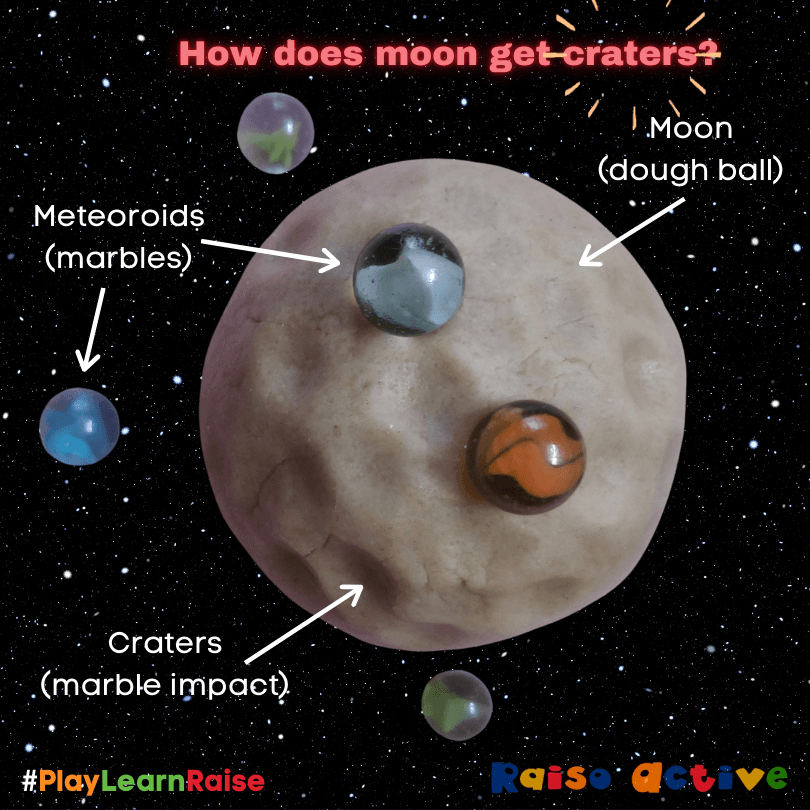
Science
Moon Crater STEM Activity: Explore Meteoroid Impacts with Dough
Children will learn how craters form on the moon by dropping marbles onto a dough ball. This hands-on STEM activity simulates meteoroid impacts, making complex science concepts engaging and easy to understand for young learners.
Share:
Topics:
craft
Ages 3-8
Video Tutorial
Log in to track your progress on this activity
Sign in to track progressWhat Your Child Will Learn
- Understand how craters are formed on celestial bodies.
- Develop fine motor skills through dropping marbles.
- Practice observation and cause-and-effect reasoning.
- Learn basic concepts of space and geology.
- Engage in hands-on STEM exploration.
Materials Needed
- Playdough or modeling clay
- Marbles (various sizes)
- Tray or baking sheet (to contain mess)
Video Tutorial
Step-by-Step Instructions
What You'll Need
• Playdough or modeling clay (light color recommended for better contrast) • Marbles (various sizes are great for showing different impact sizes) • A tray or baking sheet (to keep the activity contained)
Getting Started
• Roll the playdough into a ball or a thick, flat disc to represent the moon. Place it on the tray. • Explain to your child that the dough ball is like the Moon, and the marbles are like meteoroids, which are small rocks in space.
How to Do This Activity
• Invite your child to drop the marbles onto the "moon" from different heights. • Observe what happens when each marble hits the dough. Point out the indentations left behind. • Explain that these indentations are like the craters we see on the real Moon, formed by meteoroids crashing into its surface over millions of years. • Discuss how different marbles (meteoroids) or different drop heights (impact speeds) might create different sized or shaped craters.
Tips for Parents
• Supervise closely, especially with younger children, as marbles can be a choking hazard. • Encourage observation by asking questions like, "What do you see happening?" or "What kind of mark did that marble make?" • Connect the activity to real-world examples by showing pictures of the Moon's surface with its many craters. • Emphasize that the Moon has no atmosphere like Earth, so there's no wind or rain to wear away the craters once they form.
Ways to Extend
• Try using different materials for the "moon," such as kinetic sand or flour mixed with cocoa powder, to see how different surfaces react to impacts. • Experiment with dropping marbles from varying heights (e.g., knee height, shoulder height) to see if it changes the crater size or depth. • Research famous craters on Earth or the Moon and discuss what might have caused them. • Introduce the concept of gravity and how it pulls the meteoroids towards the Moon.