Back to Activities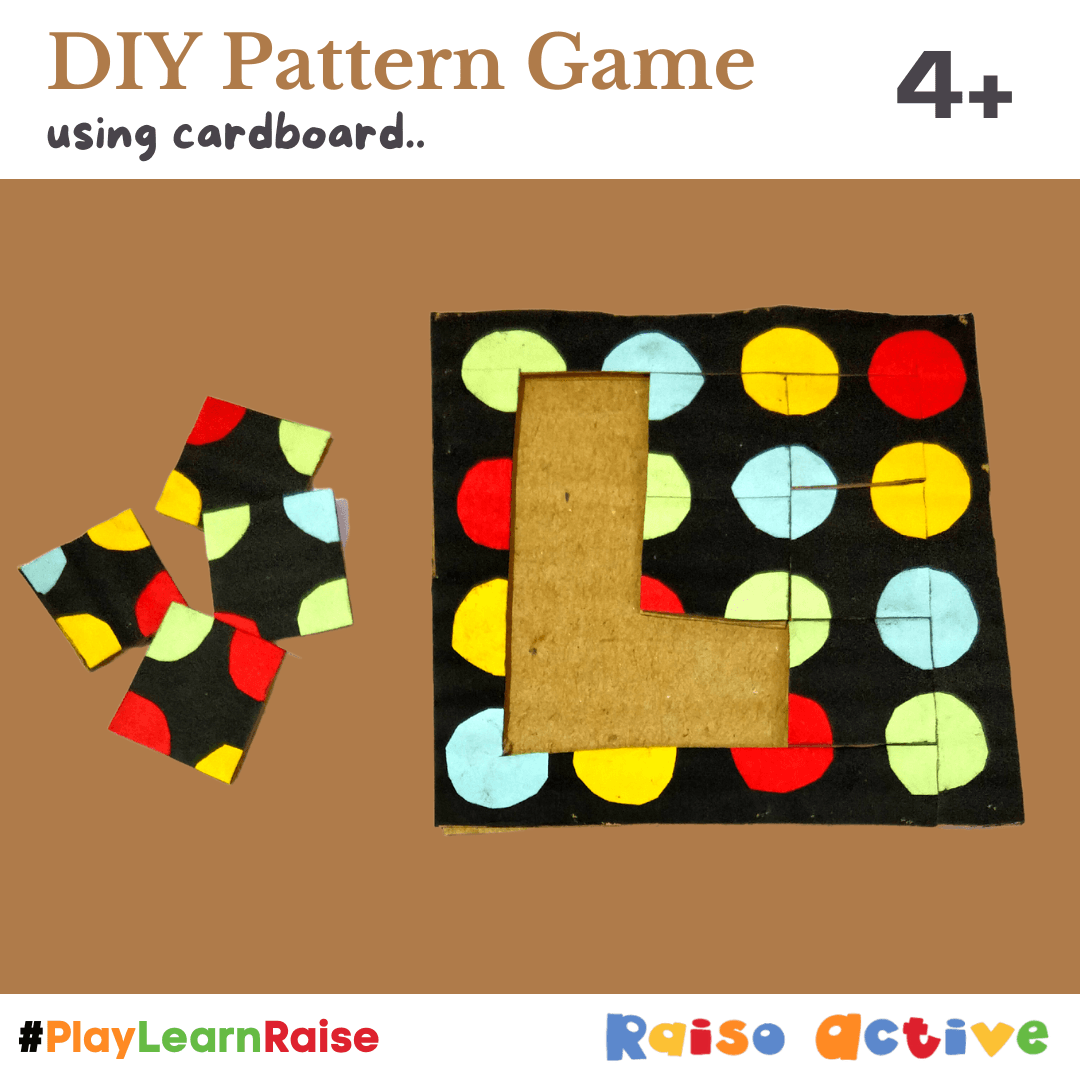
Cognitive Skills
DIY Cardboard Pattern Puzzle Game for Kids 4+
Children will love creating and solving this engaging DIY cardboard pattern puzzle. They'll match colorful pieces to complete patterns on a custom-made board, enhancing their cognitive and problem-solving abilities.
Share:
Topics:
puzzle
Ages 4-8
Video Tutorial
Log in to track your progress on this activity
Sign in to track progressWhat Your Child Will Learn
- Develop strong pattern recognition and sequencing skills.
- Enhance problem-solving abilities and logical thinking.
- Improve fine motor skills and hand-eye coordination through manipulating puzzle pieces.
- Reinforce color and basic shape recognition.
- Foster creativity and a sense of accomplishment through DIY construction and play.
Materials Needed
- Sturdy cardboard
- Scissors or craft knife
- Pencil and ruler
- Acrylic paints (red, yellow, light blue, light green) or colored paper
- Paintbrushes
- Glue stick or liquid glue
Video Tutorial
Step-by-Step Instructions
What You'll Need
• Sturdy cardboard (e.g., from a delivery box) • Scissors or a craft knife (adult supervision required) • Pencil and ruler • Acrylic paints or colored paper (red, yellow, light blue, light green, or other desired colors) • Paintbrushes (if using paint) • Glue stick or liquid glue • Optional: clear tape or laminating sheets for durability
Getting Started
First, prepare your cardboard. Cut a rectangular or square base piece for your puzzle board. Then, cut out a large 'L' shape (or any other simple shape you prefer, like a 'T' or a cross) from the center of this base. Keep the cut-out 'L' shape as a template. Next, cut several small square pieces of cardboard that are roughly the size of the individual grid segments around your cut-out shape. The image shows a 4x4 grid, so you'll need enough small squares to fill the remaining spaces and to create the actual puzzle pieces. Now, paint or glue colored paper circles onto the base board and the small square pieces. Ensure the patterns on the small squares can match the patterns on the base board around the cut-out shape, and also create additional small squares that will fit into the 'L' shape (these will be your puzzle pieces).
How to Do This Activity
• Introduce the DIY pattern puzzle to your child, explaining that the goal is to complete the picture using the smaller pieces. • Show them the main board with the 'L' shape cut out and the surrounding colorful circle patterns. • Hand them the small square puzzle pieces. Encourage them to observe the colors and the position of the circles on each piece. • Guide them to find the correct spot for each small piece, matching the colors and patterns to fill the empty 'L' shape on the board. • Encourage trial and error. If a piece doesn't fit or the pattern doesn't match, prompt them to try another one. • Continue until all the pieces are correctly placed, completing the overall pattern.
Tips for Parents
• Start with simpler patterns or fewer pieces for younger children, gradually increasing complexity. • Talk about the colors and patterns as your child plays: "Can you find the piece with the yellow circle? Where does the red circle go?" • Praise their effort and problem-solving skills, not just the correct answer. • Allow your child to explore and experiment independently, stepping in with hints only when necessary. • If using paint, let the child help paint the circles for an added creative element (after the cardboard is cut).
Ways to Extend
Create different cut-out shapes (e.g., 'T', 'cross', 'square') on new boards for varied puzzle challenges. Introduce more colors or create more intricate patterns (e.g., half circles, different sized circles) to increase the difficulty. You could also make a second set and turn it into a race or a cooperative game with multiple children. For older children, introduce patterns that require sequential thinking or even simple mathematical sequences.
.png&w=3840&q=75)